

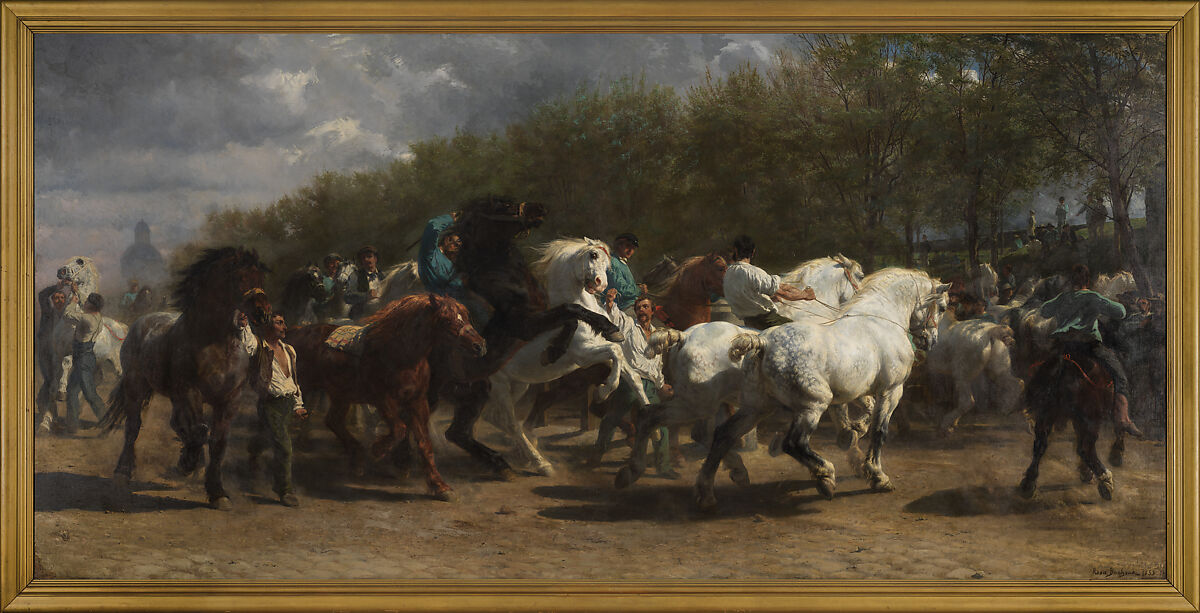
Look once for the horses, once for the composition, and once for the historical context. Treat the painting as art, not a modern training demonstration.
Begin with what catches your horse-person eye
A crowded group of horses can hold a rider’s attention before a museum label gets a chance. A turned head, a lifted foreleg, the space between a handler and a shoulder: familiar details give you a way into Rosa Bonheur’s The Horse Fair, even if you have never studied painting.
This is an invitation to look, not a test of whether you can identify every breed or piece of equipment. Separate what the museum establishes from what you notice yourself. Both can enrich the experience, provided an observation does not quietly become an invented historical fact.
Know which Horse Fair you are seeing
The Metropolitan Museum of Art dates its large oil painting to 1852–55. Its subject is the horse market on Paris’s Boulevard de l’Hôpital. The museum records that Bonheur sketched there twice weekly for a year and a half, and that the painting won praise when shown at the Paris Salon in 1853.
The National Gallery in London holds a smaller version dated 1855. Its collection account explains that a smaller version was requested to help produce prints. That distinction matters when comparing images online: a different crop, scale, or detail may belong to another version rather than a poor photograph of the same canvas.
The lead image here reproduces the Met’s painting. It is historical artwork, not a photograph of a present-day market or an illustration of recommended handling.
Take three passes through the picture
For a first pass, choose one horse and follow its outline with your eyes. Notice where its body becomes difficult to separate from another horse or handler. Ask yourself which detail first made that animal stand out. There is no need to decide whether it is the 'best' horse in the painting.
On a second pass, step back. Look for repeated light and dark shapes, the line of the horses through the scene, and places where your eye seems to travel quickly or pause. These are suggested looking exercises, not claims about what Bonheur consciously intended in every brushstroke.
On the third pass, include the people and setting. What can you actually see? What did you initially fill in from your own barn experience? Distinguishing those two things is a useful habit for looking at equestrian art, especially when familiar animals make an unfamiliar century feel deceptively close.
Compare a finished painting with a working study
The Met also holds Bonheur’s Sheet of Studies for The Horse Fair, catalogued as black chalk and graphite. Its online record offers another way to explore the subject: place a working sheet beside the finished painting and look at how a study differs from a complete scene.
Try a simple comparison with a friend or young rider. Each person chooses one detail to discuss and points to the evidence in the image. Keep the question open: 'What do you notice?' is more productive than asking someone to guess the artist’s feelings or identify a horse whose identity is not documented.
Bring curiosity back to the barn
The National Gallery’s account places the scene in a sales setting, where handlers showed horses’ movement and strength to prospective buyers. That historical explanation should not be confused with a modern endorsement of every action shown. An artwork can invite questions about handling and commerce without answering today’s welfare questions for us.
For a relaxed equestrian afternoon, pair a close look at the painting with a conversation about how horses appear in photographs, advertisements, and family albums now. Who chooses the moment? What lies outside the frame? You can appreciate the painting’s energy while staying thoughtful about what any single image can tell you about a horse.
Sources & further reading
Sources checked November 20, 2026. These are the underlying sources; MDhorse’s article is an original explanation.